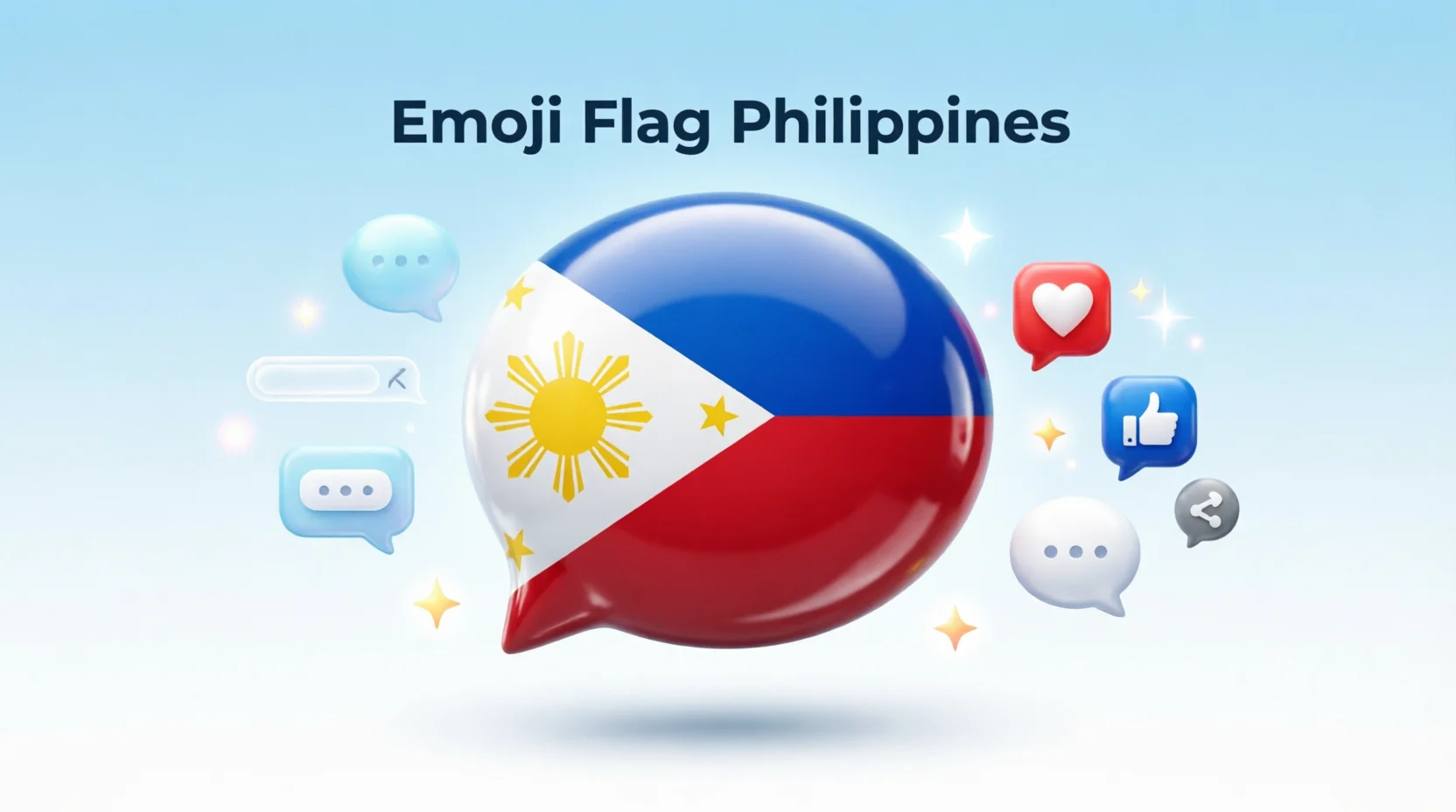
The 🇵🇭 emoji flag Philippines represents the national flag of the Philippines. It is commonly used in messages, social media posts, travel content, sports discussions, Filipino culture posts, and conversations about the country.
The emoji shows the Philippine flag with its blue and red fields, white triangle, golden sun, and three stars. The real Philippine flag is an important national symbol recognized by Philippine law. (eLibrary)
If you searched for “🇵🇭 emoji meaning,” “Philippines flag emoji,” or “what does 🇵🇭 mean,” this guide explains its meaning, appearance, history, symbolism, correct usage, and common misunderstandings.
Quick Answer: What Does 🇵🇭 Mean?
The 🇵🇭 emoji means the Philippines or Filipino identity. It is the official country-flag emoji associated with the Philippines.
People use 🇵🇭 to:
- Represent the Philippines
- Show Filipino pride or identity
- Mention Filipino culture, food, music, or traditions
- Talk about travel to or from the Philippines
- Support Philippine athletes or teams
- Identify Filipino communities
- Add a Philippine reference to social media posts
- Indicate that something is connected to the country
The emoji is based on the Philippine national flag, which features blue, white, red, a golden-yellow sun with eight rays, and three five-pointed stars. (eLibrary)
What Does the Philippines Flag Emoji 🇵🇭 Look Like?
The 🇵🇭 emoji is a digital representation of the Philippine national flag.
The actual flag has:
| Feature | Description |
|---|---|
| Blue field | Upper section during peacetime |
| Red field | Lower section during peacetime |
| White triangle | Located on the flag’s hoist side |
| Golden sun | Eight rays |
| Three stars | Five-pointed and golden |
| Flag ratio | 1:2 width-to-length ratio |
The Philippine flag is unusual because its orientation has a special meaning. During peacetime, the blue field is above the red field when the flag is flown vertically from a pole. Under Philippine law, the red field is placed above the blue field during wartime. (eLibrary)
The emoji itself normally appears as a small rectangular flag, so you may not notice every detail of the original flag design on smaller screens.
🇵🇭 What Do the Symbols on the Philippine Flag Mean?
The Philippine flag contains several important symbols. Each part has a historical and cultural connection.
The Three Stars
The flag has three five-pointed stars.
They are commonly associated with the three principal island groups of the Philippines:
- Luzon
- Visayas
- Mindanao
These three island groups are an important part of how the Philippines is geographically and culturally understood.
Historical sources also explain that the original symbolism of the three stars had a more specific revolutionary context. The National Commission for Culture and the Arts notes that the original declaration connected them with the principal islands where the revolutionary movement emerged. (NCCA)
The Eight-Rayed Sun
At the center of the white triangle is a golden-yellow sun with eight rays.
The eight rays traditionally represent the eight provinces placed under a state of war during the early Philippine Revolution against Spanish colonial rule. (Philippine News Agency)
The sun is also associated with ideas of freedom, light, progress, and independence in explanations of the flag’s symbolism.
The White Triangle
The flag contains a white equilateral triangle on the side nearest the flagpole.
Historical explanations connect the triangle with the revolutionary movement, while later educational materials describe it in terms such as equality and fraternity. (NCCA)
Blue, Red, and White
The three major colors are deeply connected with the country’s national identity.
Traditional explanations describe:
- Blue — noble ideals and high political purposes
- Red — courage, bravery, and heroism
- White — purity and peace
The golden-yellow elements add brightness and prominence to the sun and stars. (Scouts Philippines)
Why Do People Use the 🇵🇭 Emoji?
The Philippines flag emoji has many everyday uses. Its meaning depends on the surrounding text.
For example:
“I finally visited Manila! 🇵🇭”
Here, the emoji identifies the Philippines as the destination.
“Filipino food is amazing 🇵🇭❤️”
Here, it expresses a connection with Filipino culture.
“Good luck to Team Philippines! 🇵🇭”
In this case, it represents national support during a sporting event.
“Happy Independence Day, Philippines! 🇵🇭”
Here, the emoji reinforces a national celebration.
The emoji can therefore communicate much more than simply the name of a country.
🇵🇭 Philippines Flag Emoji Meaning in Different Contexts
The meaning can change slightly depending on where it appears.
| Context | Possible meaning |
|---|---|
| Travel | Visiting or traveling to the Philippines |
| Social media bio | Filipino identity or connection |
| Food post | Filipino cuisine or culture |
| Sports | Philippine athlete or team |
| Music | Filipino artist, song, or entertainment |
| Dating profile | Filipino background or interest in the Philippines |
| Business | Philippine-based company or market |
| Education | Philippine school, university, or research |
| History | Philippine historical events |
| National celebrations | Filipino patriotism or national identity |
Importantly, 🇵🇭 does not automatically reveal a person’s nationality. Someone may use the emoji because they live in the Philippines, have Filipino family, are traveling there, enjoy Filipino culture, or simply want to reference the country.
What Does 🇵🇭 Mean on Social Media?
On social media, 🇵🇭 is often used as a quick visual identifier.
A creator might write:
“New vlog from the Philippines 🇵🇭”
A traveler might write:
“Exploring Cebu 🇵🇭”
A Filipino creator could use:
“Filipino recipes you need to try 🇵🇭”
A sports fan might write:
“Let’s go, Philippines! 🇵🇭”
In each case, the basic meaning remains the Philippines, while the surrounding words provide the additional context.
🇵🇭 vs. Other Philippine Symbols
The flag emoji should not be confused with other symbols associated with the Philippines.
🇵🇭 Philippine Flag Emoji
This specifically represents the national flag of the Philippines.
Philippine Eagle
The Philippine eagle is an important national symbol and wildlife icon, but it is not the same symbol as the national flag.
National Coat of Arms
The Philippine coat of arms contains its own design, including a shield, sun, and stars. It is a separate national heraldic symbol.
Philippine Flag vs. Philippine Country Code
The emoji 🇵🇭 is a visual country flag.
The two-letter country code PH is commonly used for the Philippines in technical and internet-related contexts.
They may identify the same country, but they serve different purposes.
When Is the Philippines Flag Emoji Used?
There are many natural situations where 🇵🇭 fits well.
Travel and Tourism
Use it when discussing:
- Manila
- Cebu
- Boracay
- Palawan
- Davao
- Philippine beaches
- Philippine travel
- Filipino destinations
Example:
“Next stop: Palawan 🇵🇭”
Filipino Food
The emoji can accompany posts about:
- Adobo
- Sinigang
- Lechon
- Pancit
- Halo-halo
- Lumpia
- Filipino desserts
Example:
“Trying homemade Filipino adobo tonight 🇵🇭”
Filipino Culture
It can also appear in conversations about Filipino:
- Music
- Movies
- Festivals
- Dance
- Language
- Traditions
- History
- Art
Sports
During international competitions, people frequently use country flags to identify athletes, teams, or supporters.
Example:
“Proud of our athletes! 🇵🇭”
A Brief History of the Philippine Flag
The modern Philippine flag has roots in the country’s revolutionary history.
Historical sources identify Emilio Aguinaldo as the designer of the flag. It was sewn in Hong Kong by Marcela Agoncillo, Lorenza Agoncillo, and Delfina Herbosa de Natividad. (Philippine News Agency)
The flag was first raised in connection with the Philippine revolutionary struggle in 1898. It was displayed after the Battle of Alapan on May 28, 1898, and was later prominently used during the proclamation of Philippine independence on June 12, 1898, in Kawit, Cavite. (NCIP)
Today, May 28 to June 12 is recognized as the Philippines’ Flag Days period under the national flag code, encouraging the display of the flag. (eLibrary)
Why Does the Philippine Flag Have Red on Top Sometimes?
This is one of the most interesting facts about the Philippine flag.
During peacetime, the blue field is placed above the red field when the flag is flown from a pole.
During wartime, the red field is placed above the blue field.
This is not simply a design variation. Philippine law specifically establishes the different orientations. (eLibrary)
That means the Philippine flag can communicate an important national circumstance through its orientation.
This feature also makes the Philippine flag distinctive among national flags.
Philippine Flag Emoji vs. Real Philippine Flag
Although the emoji represents the national flag, a digital emoji is not a complete substitute for the physical flag.
The real flag has legally specified proportions, colors, construction standards, and rules for display. Republic Act No. 8491 establishes the Philippine National Flag’s design and rules for its use. (eLibrary)
For casual digital communication, however, 🇵🇭 is simply the convenient emoji representation.
Important difference
🇵🇭 = digital emoji
Physical Philippine flag = official national symbol governed by law
This distinction is useful when discussing ceremonies, government use, official displays, or flag etiquette.
Common Mistakes About 🇵🇭
Mistake 1: Thinking It Means Only “Filipino”
The emoji primarily represents the Philippines as a country.
It can suggest Filipino identity depending on context, but the emoji itself does not prove that the person using it is Filipino.
Mistake 2: Confusing the Flag With the Country Code
PH and 🇵🇭 can both refer to the Philippines, but they are different forms of identification.
Mistake 3: Assuming the Three Stars Represent Any Three Cities
The stars have historical and geographic symbolism associated with the country’s major island groups. They are not simply symbols for three particular cities.
Mistake 4: Forgetting the Wartime Orientation
The Philippine flag has a special rule in which the red field is placed above the blue field during wartime. (eLibrary)
Mistake 5: Treating Every Emoji Use as a Political Statement
Using 🇵🇭 can be completely ordinary. Someone may use it simply to identify a location, food, trip, language, culture, or event.
Context matters.
Practical Tips for Using 🇵🇭
If you want to use the Philippines flag emoji naturally, consider these simple tips:
- Use 🇵🇭 when directly referring to the Philippines.
- Pair it with travel posts about Philippine destinations.
- Use it with Filipino food content when the food or recipe is relevant.
- Add it to sports posts involving Philippine athletes or teams.
- Use it for cultural content connected to Filipino traditions.
- Combine it with other relevant emojis when appropriate, such as food, travel, music, or celebration emojis.
- Let the surrounding words provide context rather than relying on the flag alone.
- Remember that the emoji is digital, while the physical national flag has formal rules governing its display.
FAQs:
1. What country does 🇵🇭 represent?
🇵🇭 represents the Philippines, an island country in Southeast Asia.
2. What does the 🇵🇭 emoji mean on Instagram?
On Instagram, 🇵🇭 usually identifies the Philippines or something connected with Filipino culture, people, travel, food, sports, or events. The exact meaning depends on the post.
3. What does 🇵🇭 mean in texting?
In texting, 🇵🇭 is generally a quick way to say or indicate the Philippines. It can also express Filipino pride or a personal connection with the country.
4. What do the three stars on the Philippine flag represent?
The three stars are associated with the Philippines’ three major island groups: Luzon, Visayas, and Mindanao. Historical accounts provide additional context about their original revolutionary symbolism. (NCCA)
5. What do the eight rays on the Philippine flag mean?
The eight rays of the sun traditionally represent the eight provinces involved in the early Philippine Revolution against Spanish rule. (Philippine News Agency)
6. Why is the Philippine flag sometimes shown with red on top?
The red field is placed above the blue field when the Philippine flag is displayed to indicate wartime, while blue is above red during peacetime. (eLibrary)
7. When is Philippine National Flag Day?
May 28 is National Flag Day, and the official Flag Days period runs from May 28 through June 12, according to Republic Act No. 8491. (eLibrary)
8. Is 🇵🇭 the official Philippine flag?
🇵🇭 is the digital emoji representation of the Philippine national flag. The actual national flag is legally defined as blue, white, and red with an eight-rayed golden-yellow sun and three five-pointed stars. (eLibrary)
Conclusion
The 🇵🇭 emoji flag Philippines is a simple digital symbol with a much deeper national history behind it. It represents the Philippines and can be used when talking about Filipino identity, travel, culture, food, sports, history, celebrations, or everyday life. Its design comes from the Philippine national flag, featuring the white triangle, golden sun, eight rays, three stars, and blue and red fields.
Understanding 🇵🇭 also means understanding the symbolism behind the physical Philippine flag. Its colors, stars, sun, and distinctive peacetime and wartime orientation are connected with the country’s history and national identity. If you see 🇵🇭 in a text message, social media caption, travel post, or cultural discussion, its basic message is clear: the Philippines.