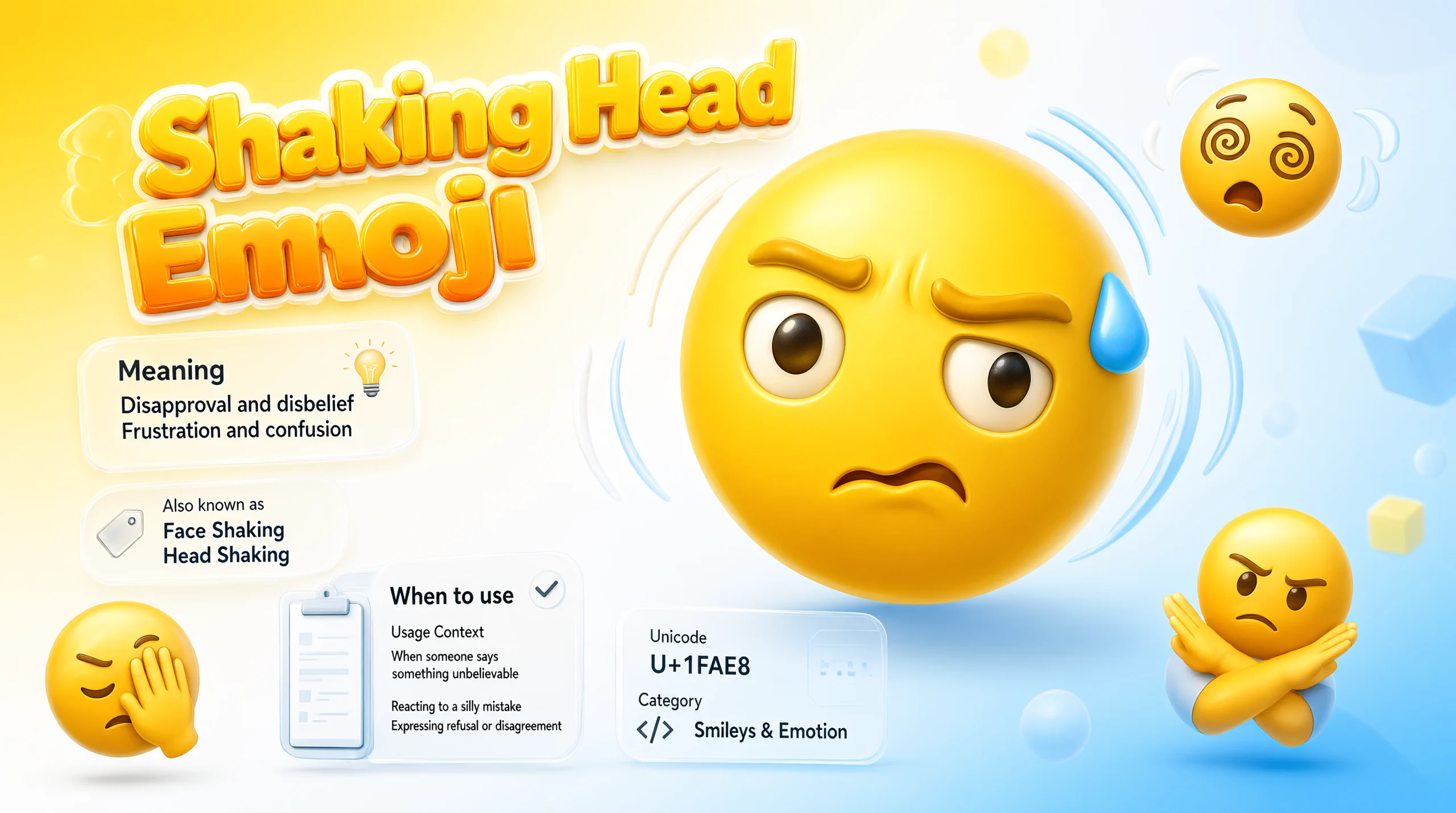
The shaking head emoji is a simple way to express disagreement, disbelief, confusion, disappointment, or a reaction to something unexpected. Depending on the emoji you choose, it can communicate anything from a playful “no” to a serious expression of concern. The two main emojis associated with this gesture are 🙅 (Person Gesturing No) and the head-shaking symbols often represented through descriptions, stickers, GIFs, or animated reactions. Understanding the difference helps you choose the right expression for text messages, social media posts, and online conversations.
If you want to show that you disagree with a statement, react to surprising news, or communicate a friendly refusal, head-shaking expressions can make your message easier to understand. This guide explains their meanings, differences, common uses, examples, and tips for choosing the right emoji in 2026.
Quick Answer: What Does the Shaking Head Emoji Mean?
The shaking head emoji usually represents saying “no,” disagreeing, expressing disbelief, or reacting negatively to something. Its meaning depends on the symbol, the conversation, and the relationship between the people communicating.
For example:
- 🙅: No, stop, or I disagree.
- 🙅♀️: A woman gesturing no.
- 🙅♂️: A man gesturing no.
- 🤦: Frustration, embarrassment, or disbelief about a situation.
- 😵💫: Confusion, dizziness, or feeling overwhelmed.
If you want to express a simple refusal, 🙅 is a useful choice. If you want to show that something is confusing or unbelievable, 🤦 or 😵💫 may communicate your reaction more clearly.
Important: There is no single standard Unicode emoji officially named “Shaking Head Emoji.” People may use this phrase to describe different head movements, gestures, stickers, or animated reactions.
What Is the Shaking Head Emoji?
The shaking head emoji is a general term for digital expressions that imitate the movement of someone shaking their head. In everyday communication, this movement often means “no,” “I disagree,” or “I cannot believe this.”
However, head movements do not always have the same meaning in every situation. Someone might shake their head because they are confused, disappointed, amused, or surprised.
In digital conversations, emojis help communicate these emotions without requiring a long explanation.
For example, imagine that your friend says they forgot their phone at home for the third time this week. You might respond with 🤦 to show disbelief or frustration.
If someone asks whether you want to participate in an activity you dislike, 🙅 can communicate a clear refusal.
The exact meaning depends on the surrounding message.
Different Emojis That Can Represent Shaking Your Head
Several standard emojis can communicate feelings associated with shaking your head. Choosing the right one makes your message more accurate.
| Emoji | Common meaning | When to use it |
| 🙅 | No, refusal, or disagreement | Rejecting an invitation or request |
| 🙅♀️ | Woman gesturing no | Expressing refusal with a feminine character |
| 🙅♂️ | Man gesturing no | Expressing refusal with a masculine character |
| 🤦 | Frustration, embarrassment, or disbelief | Reacting to an obvious mistake |
| 😵💫 | Confusion or feeling overwhelmed | Responding to complicated or confusing information |
| 😒 | Annoyance or dissatisfaction | Showing that you are unimpressed |
| 🙄 | Eye-rolling, impatience, or sarcasm | Reacting to an irritating comment |
| 😔 | Sadness or disappointment | Expressing a disappointed reaction |
These emojis are not interchangeable in every situation. For example, 🙅 communicates a refusal more directly than 😔, while 🙄 often suggests irritation or sarcasm.
There is also a difference between a literal head-shaking animation and a standard emoji. A GIF or sticker can show the actual movement of a head from side to side, while a static emoji communicates a related meaning through a facial expression or gesture.
What Does the Shaking Head Emoji Mean in Text Messages?
In text messages, a head-shaking expression can communicate different feelings depending on the conversation.
1. Disagreement
The most straightforward meaning is disagreement.
For example:
Friend: “I think staying awake all night before an exam is a great idea.”
You: “🙅 No way!”
Here, the emoji reinforces your rejection of the suggestion.
2. Disbelief
Sometimes, people use head-shaking expressions when they hear something surprising or difficult to believe.
Example:
Friend: “He watched the entire series in one day.”
You: “🤦 How is that even possible?”
The emoji communicates disbelief, although it does not literally mean that the person is shaking their head.
3. Disappointment
A head-shaking reaction can also suggest that something did not happen as expected.
Example:
Friend: “The concert was canceled at the last minute.”
You: “😔 That’s disappointing.”
In this case, the sad emoji communicates disappointment more clearly than a refusal gesture.
4. Playful Frustration
Friends often use expressive emojis to tease one another or react humorously to silly mistakes.
Example:
Friend: “I put my keys in the refrigerator.”
You: “🤦😂 How did you manage that?”
The combination of emojis shows that you are surprised and amused rather than genuinely angry.
5. Refusing an Invitation
When someone invites you to an event, a no-gesture emoji can make your response clear.
Example:
Friend: “Want to go shopping at midnight?”
You: “🙅 Not tonight!”
This response is short, friendly, and easy to understand.
Shaking Head Emoji Meaning on Social Media
On social media platforms, emojis often function as quick reactions to videos, comments, jokes, and trending topics.
A head-shaking expression may communicate disapproval, disbelief, humor, or frustration without requiring a detailed comment.
On TikTok
TikTok users may use head-shaking videos, reaction GIFs, stickers, or emojis to respond to surprising or questionable content.
For example, someone watching an unbelievable video might comment:
“I’m actually shaking my head at this 🤦😂”
This communicates a mixture of disbelief and amusement.
On Instagram
On Instagram, people may use 🙅, 🙄, or 🤦 in captions, Stories, and comments.
Examples include:
- “Monday mornings again 🙄”
- “Absolutely not 🙅”
- “I cannot believe I did that 🤦”
Each expression conveys a slightly different feeling.
On WhatsApp
WhatsApp conversations are often informal, making expressive emojis useful for communicating tone.
For example:
- “Are you serious? 🤦”
- “No thanks 🙅”
- “Not this again 🙄”
- “I have no words 😵💫”
The emoji helps clarify whether the message is playful, annoyed, confused, or dismissive.
On Facebook
Facebook users may use head-shaking expressions to respond to news, personal updates, jokes, or discussions.
However, these symbols can sometimes appear stronger than intended. When discussing a sensitive topic, a written explanation may communicate your position more respectfully.
Shaking Head Emoji vs. Facepalm Emoji
The shaking head emoji and the facepalm emoji are related in everyday use, but they do not have exactly the same meaning.
The facepalm emoji, 🤦, depicts a person covering their face with one hand. It usually communicates embarrassment, frustration, disappointment, or disbelief.
A head-shaking gesture, by contrast, involves moving the head from side to side. It often communicates disagreement or refusal.
Compare these examples:
| Situation | Better choice | Why |
| Rejecting an invitation | 🙅 | Clearly expresses no |
| Reacting to a silly mistake | 🤦 | Shows frustration or disbelief |
| Responding sarcastically | 🙄 | Suggests annoyance or impatience |
| Feeling confused | 😵💫 | Communicates confusion or disorientation |
| Feeling disappointed | 😔 | Expresses sadness or disappointment |
Example:
“I am not going to that party 🙅”
This means you are refusing the invitation.
“I forgot my own birthday plans 🤦”
This communicates embarrassment or disbelief about your mistake.
The two expressions can sometimes be used in similar conversations, but their visual meanings are different.
How to Copy and Paste the Shaking Head Emoji
If you want to use a head-shaking expression in a message, you can copy one of the following symbols.
Copy these emojis:
- No gesture: 🙅
- Woman gesturing no: 🙅♀️
- Man gesturing no: 🙅♂️
- Facepalm: 🤦
- Eye-roll: 🙄
- Dizzy or confused face: 😵💫
- Disappointed face: 😔
To copy an emoji on a computer, select the symbol, right-click, and choose Copy. Then paste it into your message, caption, or comment.
On a smartphone, press and hold the emoji if your keyboard or application allows selection and copying. You can also open your device’s emoji keyboard and search for terms such as “no,” “facepalm,” or “eye roll.”
Emoji names and search results can vary slightly between keyboards and applications.
How to Type an Emoji on Windows
On Windows 10 and Windows 11, you can generally open the emoji panel by pressing Windows key + . (period).
Then:
- Open the application where you want to type.
- Place the cursor in the text field.
- Press Windows key + period.
- Search for an appropriate emoji or browse the available categories.
- Select the symbol to insert it.
The exact appearance of an emoji may differ depending on your operating system, application, and font support.
Why Does the Shaking Head Emoji Look Different on Different Devices?
Emojis are standardized characters, but their visual designs are created by individual platform developers.
As a result, the same emoji may look slightly different on an iPhone, Android phone, Windows computer, or social media application.
Differences may include:
- Facial expressions
- Hand positions
- Character design
- Colors and shading
- Overall proportions
These differences generally do not change the emoji’s basic intended meaning, but they can influence how expressive it appears.
For example, one platform may depict a gesture with a more pronounced hand position, while another may use a simpler design.
A GIF or sticker can vary even more because it may be created by an individual artist or an application rather than being a standard emoji character.
If you want to show an actual head shaking from side to side, an animated GIF or sticker may be more suitable than a static emoji.
Can You Use a Shaking Head Emoji to Be Sarcastic?
Yes. Emojis associated with disagreement, frustration, or disbelief can be used sarcastically, particularly in conversations between friends.
For example:
“Great, another meeting that could have been an email 🙄”
The eye-roll suggests that the speaker is annoyed rather than genuinely enthusiastic.
Similarly:
“Of course I forgot my umbrella on the rainiest day of the year 🤦”
The facepalm communicates self-directed frustration in a humorous way.
However, sarcasm can be difficult to interpret in written communication. Someone who does not know you well might misunderstand your message.
When communicating with coworkers, customers, or people you do not know personally, use emojis carefully. A brief explanation can prevent confusion.
Common Mistakes When Using the Shaking Head Emoji
Although emojis are simple to use, some common mistakes can lead to misunderstandings.
1. Assuming Every Head-Shaking Expression Means No
Head shaking often communicates refusal or disagreement, but its meaning depends on the situation.
A person may shake their head because they are disappointed, confused, amused, or surprised.
Consider the complete message rather than interpreting a gesture in isolation.
2. Confusing Facepalm With a Literal Head Shake
The 🤦 emoji depicts a facepalm, not a person shaking their head.
It can communicate a similar feeling of disbelief, but it represents a different physical gesture.
If you want to show an actual head moving from side to side, consider using a suitable GIF or animated sticker.
3. Using an Emoji That Sounds Too Harsh
The 🙅 emoji may seem direct or forceful in some situations.
For example, replying only with 🙅 to a serious invitation could appear dismissive.
A friendlier response might be:
“Thanks for inviting me, but I can’t make it this time 😊”
This communicates refusal without sounding unnecessarily rude.
4. Ignoring the Context
The same emoji can communicate different emotions in different conversations.
For example, 🤦 may indicate genuine frustration in one message and playful embarrassment in another.
The words surrounding the emoji help determine its intended meaning.
5. Using Too Many Emojis
Adding several emojis to every sentence can make a message harder to understand.
Choose one or two symbols that express your reaction clearly.
For example, “I can’t believe that happened 🤦😂” is usually easier to interpret than a long sequence of unrelated expressions.
Practical Tips for Using Head-Shaking Expressions
Use these simple tips to make your messages clearer and more natural.
Choose the emoji that matches your emotion. Use 🙅 for refusal, 🤦 for frustration or disbelief, and 🙄 for an eye-rolling reaction.
Consider your audience. A playful emoji may be appropriate among friends but less suitable in a formal work conversation.
Add words when the message matters. If you are declining an invitation or explaining a disagreement, a short sentence can make your meaning clearer.
Check how the emoji appears. Different devices and applications may display the same symbol differently.
Use GIFs for movement. If your goal is to show a person physically shaking their head, an animated image may communicate the action more accurately than a static emoji.
Avoid assuming emotional intent. An emoji alone cannot always reveal what another person feels. Consider the full conversation before drawing conclusions.
FAQs:
1. What is the shaking head emoji?
The phrase “shaking head emoji” generally describes an emoji, sticker, or animated reaction associated with shaking the head. 🙅 can communicate no or refusal, while 🤦 can express disbelief or frustration.
2. Is there an official shaking head emoji?
There is no single standard Unicode emoji officially named “Shaking Head Emoji.” People commonly use related symbols, such as 🙅 and 🤦, or animated GIFs to communicate a similar reaction.
3. What does 🙅 mean?
The 🙅 emoji represents a person gesturing no. It can communicate refusal, disagreement, rejection, or a request to stop, depending on the context.
4. What is the difference between 🙅 and 🤦?
The 🙅 emoji communicates no or refusal through a hand gesture. The 🤦 emoji depicts a facepalm and commonly expresses embarrassment, frustration, or disbelief.
5. Can the shaking head emoji mean disappointment?
Yes. A head-shaking gesture may communicate disappointment, especially when something goes wrong or does not meet expectations. However, 😔 may be a clearer choice when you specifically want to express sadness.
6. Which emoji should I use to show disbelief?
The 🤦 emoji is a useful option for expressing disbelief, frustration, or embarrassment. The 🙄 emoji may work better when your reaction is sarcastic or impatient.
7. How can I copy and paste a shaking head emoji?
Choose a related symbol, such as 🙅, 🤦, or 🙄, and copy it into your message. You can also use your device’s emoji keyboard to search for an appropriate expression.
8. Why does the shaking head emoji look different on my phone?
Emoji designs vary between operating systems, applications, and devices. These differences usually affect the visual appearance rather than the symbol’s basic intended meaning. Animated stickers and GIFs may have entirely different designs.
Conclusion
The shaking head emoji is a useful way to communicate reactions such as disagreement, refusal, disbelief, and frustration in digital conversations. Although there is no single standard Unicode emoji officially named “Shaking Head Emoji,” related symbols such as 🙅, 🤦, and 🙄 can express many of the feelings associated with this gesture. Choosing the right symbol depends on what you want to communicate and how your audience might interpret it.
For everyday messages, use 🙅 when you want to say no, 🤦 when reacting to a mistake or unbelievable situation, and 🙄 when expressing sarcasm or annoyance. If you want to show a person physically shaking their head, consider using an animated GIF or sticker. By matching the expression to the context, you can make your messages clearer, more natural, and easier to understand.