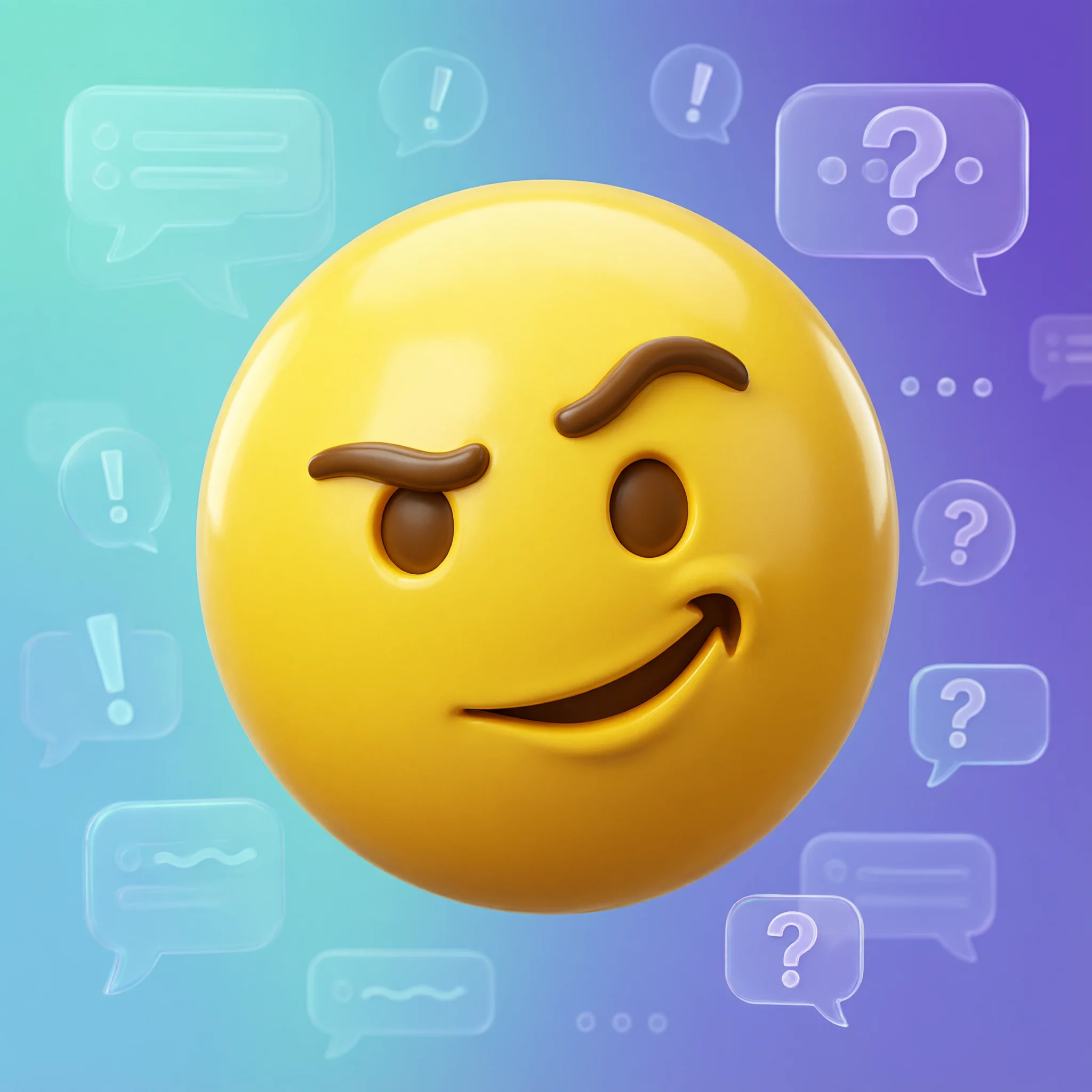
The sarcasm emoji helps people express irony, teasing, playful criticism, or a statement that means something different from its literal words. There is no single universally recognized official emoji dedicated exclusively to sarcasm, but several emojis can communicate a sarcastic tone. Popular choices include 🙃 (upside-down face), 🙄 (face with rolling eyes), 😏 (smirking face), and 😒 (unamused face). The best choice depends on whether you want to sound playful, annoyed, cheeky, or deliberately ironic.
Quick Answer: What Is the Sarcasm Emoji?
A sarcasm emoji is an emoji used to show that a message is sarcastic rather than completely serious. People often use 🙃, 🙄, 😏, and 😒 to communicate sarcasm in text messages, social media comments, memes, and online conversations.
Here is a quick guide:
- 🙃 Upside-Down Face: Playful sarcasm, awkward humor, or pretending everything is fine.
- 🙄 Face with Rolling Eyes: Obvious sarcasm, disbelief, or annoyance.
- 😏 Smirking Face: Cheeky remarks, teasing, or knowing sarcasm.
- 😒 Unamused Face: Dry sarcasm, irritation, or disappointment.
- 😑 Expressionless Face: Deadpan humor or a reaction to something ridiculous.
- 🤡 Clown Face: Mocking a foolish decision or making fun of yourself.
- 🙂 Slightly Smiling Face: Sometimes used for passive-aggressive politeness or hidden frustration.
These emojis do not have an official universal definition of sarcasm. Their meaning depends on the message, the conversation, and the relationship between the people communicating.
What Does the Sarcasm Emoji Mean?
The sarcasm emoji can communicate that someone is joking, exaggerating, criticizing something indirectly, or saying the opposite of what they genuinely mean.
For example, imagine your friend arrives 45 minutes late and says, “Sorry, traffic was terrible.”
You might reply:
“Wow, you’re always right on time 🙄”
The rolling-eyes emoji signals that you do not literally believe your friend is always punctual. Instead, you are teasing them about being late.
Sarcasm often depends on tone of voice, facial expressions, and shared understanding. Since digital messages lack many of these signals, emojis can help readers interpret the intended meaning.
Common Meanings of Sarcasm Emojis
Depending on the situation, a sarcasm emoji may express:
- Playful teasing: Making fun of a friend without intending to hurt their feelings.
- Irony: Saying something that contrasts with the actual situation.
- Disbelief: Reacting to an unbelievable statement or excuse.
- Annoyance: Expressing frustration through a sarcastic response.
- Dry humor: Delivering a joke with a straight-faced or emotionless tone.
- Self-deprecating humor: Making fun of your own mistakes.
- Passive-aggressive communication: Expressing dissatisfaction indirectly rather than stating it openly.
Understanding these differences helps you choose an emoji that matches your intended tone.
Best Emojis for Sarcasm and Their Meanings
Several standard emojis work well when you want to communicate sarcasm. However, each one creates a slightly different impression.
| Emoji | Common name | Sarcastic meaning | Best use |
| 🙃 | Upside-Down Face | Playful irony or pretending things are fine | Funny situations and awkward moments |
| 🙄 | Face with Rolling Eyes | Disbelief or obvious sarcasm | Responding to excuses or ridiculous claims |
| 😏 | Smirking Face | Cheekiness or knowing humor | Teasing friends and playful remarks |
| 😒 | Unamused Face | Dry sarcasm or irritation | Showing disappointment |
| 😑 | Expressionless Face | Deadpan humor or disbelief | Reacting to something absurd |
| 🙂 | Slightly Smiling Face | Possible passive aggression or restrained frustration | Ironic politeness |
| 🤡 | Clown Face | Mocking foolish behavior | Jokes about bad decisions |
| 😬 | Grimacing Face | Awkwardness or uncomfortable irony | Embarrassing situations |
| 😌 | Relieved Face | Feigned satisfaction or smug humor | Playful exaggeration |
| 💀 | Skull | Finding something extremely funny | Sarcastic memes and internet jokes |
Remember that these are common conversational interpretations, not fixed meanings. A person might use 😏 flirtatiously, 🙃 sincerely, or 💀 to express laughter rather than sarcasm.
1. 🙃 Upside-Down Face: The Playful Sarcasm Emoji
The upside-down face is one of the most versatile emojis for expressing irony.
It can suggest that something is funny, awkward, frustrating, or completely ridiculous. People often use it when they want to make a sarcastic comment without sounding too aggressive.
Examples:
- “Everything is going perfectly today 🙃”
- “I absolutely love having five deadlines at once 🙃”
- “Another Monday morning. My favorite 🙃”
In each example, the surrounding words suggest that the person may not be enjoying the situation.
Best for: Friendly teasing, awkward moments, ironic complaints, and lighthearted sarcasm.
2. 🙄 Rolling Eyes Emoji: The Obvious Sarcasm Reaction
The rolling-eyes emoji is useful when you want to express disbelief, impatience, or annoyance.
It can make sarcasm more obvious because it resembles a familiar facial reaction to something irritating or unbelievable.
Examples:
- “Oh yes, because that makes total sense 🙄”
- “You forgot your keys again? Amazing 🙄”
- “Sure, I’ll just finish everything in five minutes 🙄”
This emoji can sound more confrontational than 🙃, especially when responding to someone during an argument.
Best for: Responding to excuses, unbelievable statements, repetitive mistakes, or frustrating situations.
3. 😏 Smirking Face: Cheeky and Clever Sarcasm
The smirking face communicates confidence, mischief, or a sense that you know something the other person does not.
It can make a sarcastic message sound playful, clever, or slightly provocative.
Examples:
- “Oh, you finally remembered my birthday 😏”
- “Nice work. Took you long enough 😏”
- “Of course you won. Totally unexpected 😏”
The meaning depends heavily on context. This emoji can also suggest flirting or smugness, so it is not always the best option for professional communication.
Best for: Friendly banter, teasing, playful challenges, and cheeky comments.
4. 😒 Unamused Face: Dry Sarcasm
The unamused face is useful when something is irritating, disappointing, or unimpressive.
Unlike the rolling-eyes emoji, it can communicate dissatisfaction without an exaggerated reaction.
Examples:
- “Great, another meeting that could have been an email 😒”
- “Fantastic. The internet stopped working again 😒”
- “That was definitely worth waiting an hour for 😒”
This emoji works particularly well with dry humor because its expression looks unimpressed.
Best for: Disappointment, understated criticism, and sarcastic complaints.
5. 😑 Expressionless Face: Deadpan Sarcasm
Deadpan humor involves delivering a joke or sarcastic remark without showing much emotion.
The expressionless face can reinforce that style by suggesting that the speaker is unimpressed or has no words for the situation.
Examples:
- “You put your phone in the refrigerator? Brilliant 😑”
- “I love explaining the same thing for the sixth time 😑”
- “What a completely normal decision 😑”
This emoji is especially useful when the situation itself makes the joke obvious.
Best for: Dry jokes, ridiculous situations, and understated reactions.
How to Use the Sarcasm Emoji in Text Messages
Choosing the right emoji depends on what you want the other person to understand.
Use Sarcasm With Friends
Friends often understand each other’s humor, making playful sarcasm easier to communicate.
Examples include:
- “You’re only two hours late. Impressive 🙃”
- “Wow, you actually cleaned your room 😏”
- “Thanks for sharing that extremely useful information 🙄”
- “You’re a genius, obviously 😑”
These messages can sound affectionate or critical depending on your relationship and the surrounding conversation.
If your friend is sensitive about a particular subject, choose your words carefully even when you intend to joke.
Use Sarcasm in Group Chats
Group chats are full of jokes, reactions, and playful exaggeration.
A well-chosen emoji can make a short response more expressive.
For example:
Friend: “I stayed awake until 4 a.m. watching videos.”
You: “Excellent sleep schedule 🙃”
Or:
Friend: “I forgot my assignment again.”
You: “Academic excellence at its finest 😏”
The humor comes from the difference between the positive wording and the less-than-ideal situation.
Use Sarcasm on Social Media
Sarcasm is common in social media captions, comments, memes, and replies.
Examples include:
- “Living my best life while my responsibilities multiply 🙃”
- “Another productive day of procrastination 😌”
- “Nothing says success like forgetting why you entered a room 😑”
- “Absolutely thriving on three hours of sleep 🙃”
These captions work because they exaggerate everyday frustrations in a relatable way.
However, sarcasm directed at strangers can be interpreted as hostility. Consider whether your audience will understand the joke before posting.
Sarcasm Emoji Examples for Different Situations
The same emoji can communicate different feelings depending on the situation.
The following examples show how to use sarcastic expressions naturally.
| Situation | Sarcastic message | Suggested emoji |
| Someone arrives late | “Wow, right on schedule!” | 🙄 |
| You make a mistake | “Clearly, I’m a professional 🙃” | 🙃 |
| A friend makes an obvious joke | “Comedy legend right here 😏” | 😏 |
| Your computer crashes | “Technology is amazing 😒” | 😒 |
| Someone states the obvious | “Really? I had no idea 😑” | 😑 |
| Plans get canceled again | “Love how organized everything is 🙃” | 🙃 |
| You make a foolish decision | “Genius move by me 🤡” | 🤡 |
| Something unexpectedly goes wrong | “Exactly what I needed today 🙃” | 🙃 |
These examples demonstrate a useful principle: the words establish the sarcastic idea, while the emoji provides an additional emotional clue.
Short Sarcasm Emoji Messages
If you want something quick for a text message, these combinations are easy to adapt:
- “Sure, why not 🙃”
- “What could possibly go wrong? 😏”
- “Absolutely brilliant 🙄”
- “Love that for me 🙃”
- “Well, that went perfectly 😑”
- “I’m shocked. Truly 😏”
- “Best day ever 🙃”
- “Such a genius idea 🤡”
- “How wonderful 😒”
- “Totally believable 🙄”
Use these phrases when the surrounding conversation makes the joke clear. Without context, some of them may sound sincere rather than sarcastic.
Is There an Official Sarcasm Emoji?
There is no universally recognized standard emoji whose sole official purpose is to represent sarcasm.
The standard emoji collection includes expressions that people commonly use sarcastically, such as 🙃, 🙄, 😏, and 😒. However, these characters have broader meanings.
Unicode is the standard used to encode emoji characters across digital platforms. It assigns standardized names and character identities to emoji, but the way people use an emoji can develop through everyday communication and internet culture.
Some websites, fonts, or communities may offer custom symbols designed specifically to indicate sarcasm. These are not necessarily standard emoji that will display consistently on every device.
What About the Sarcasm Mark?
The sarcasm mark is a proposed punctuation symbol intended to signal sarcasm in written communication.
Different proposals have used different designs, and none has become a universally adopted replacement for ordinary punctuation or emoji.
For everyday messaging, most people rely on context, familiar emojis, or explicit markers such as “/s” to show that a statement is sarcastic.
For example:
“I really enjoy waiting in traffic /s”
The marker “/s” is widely used in online communities to indicate sarcasm, although not everyone recognizes it.
Sarcasm Emoji vs. Irony Emoji: What Is the Difference?
Sarcasm and irony are related, but they are not identical.
Irony involves a contrast between what is expected and what happens, or between what is said and what is meant.
Sarcasm is a form of expression that often uses irony to mock, criticize, tease, or communicate frustration.
For example, imagine someone gets caught in heavy rain immediately after washing their car.
They might say, “Wonderful weather today 🙃.”
The situation is ironic because the weather has spoiled their plans.
Now imagine someone repeatedly ignores your advice and then complains about the predictable result. You reply, “Well, that worked out brilliantly 🙄.”
That response is sarcastic because it uses praise to criticize the person’s decision.
The same emojis can represent both irony and sarcasm. The intended meaning usually becomes clear through the words and situation.
Sarcasm Emoji on Different Platforms
Sarcastic emojis can be used on nearly any modern platform that supports standard emoji, including messaging apps, social networks, email clients, and discussion forums.
However, appearance and interpretation may vary.
In WhatsApp conversations, 🙃, 🙄, and 😏 are useful for playful remarks, reactions, and friendly teasing.
For example:
“Thanks for telling me after the event ended 🙃”
The emoji helps signal frustration mixed with humor.
On Instagram, sarcasm emojis often appear in captions, comments, stories, and replies.
For example:
“Me pretending everything is under control 🙃”
The emoji reinforces the contrast between the words and the actual situation.
TikTok
TikTok users may use sarcasm emojis in comments, captions, and reactions to funny videos.
For example:
“Definitely the best decision I’ve ever made 😭”
Although 😭 is primarily a loudly crying face, it is frequently used online to communicate exaggerated emotion or laughter. Its meaning depends on the community and context.
Discord and Online Forums
Online communities often combine emojis with text markers such as “/s” to clarify jokes.
For example:
“Yeah, deleting the entire project was a fantastic idea /s”
This makes the sarcastic intention more explicit for readers who might otherwise misunderstand the message.
Email and Workplace Chats
Sarcasm can be risky in professional conversations because short messages lack vocal tone and facial expressions.
A message such as “Great job missing the deadline 🙄” may sound insulting rather than humorous.
For workplace communication, it is usually better to state concerns directly and respectfully.
How to Type or Copy Sarcasm Emojis
You do not need a special application to use common sarcasm emojis.
On Windows
- Open the application where you want to type.
- Press Windows key + . (period).
- Open the emoji panel.
- Search for an expression or browse the available emojis.
- Select the emoji you want to insert.
You can also copy an emoji directly from this article.
On Mac
- Place the cursor in a text field.
- Press Control + Command + Space to open the character viewer.
- Search for an emoji by name or browse the categories.
- Select the emoji to insert it.
Keyboard shortcuts and available features may vary slightly by operating system version and application.
On Android and iPhone
Open your keyboard’s emoji panel and choose the expression that matches your intended tone.
You can also copy these emojis:
Playful sarcasm: 🙃 😏 😌
Annoyed sarcasm: 🙄 😒 😑
Self-deprecating sarcasm: 🤡 💀 😬
Sarcastic reactions: 🙂 🙃 🙄
The best choice is the one that communicates your meaning without creating unnecessary confusion.
Common Mistakes When Using Sarcasm Emojis
Even a familiar emoji can create misunderstandings when used in the wrong situation.
1. Assuming Everyone Understands Sarcasm
Not everyone interprets humor in the same way.
A message that seems obviously sarcastic to you may appear sincere to another person.
Better approach: Add enough context to make your intention clear.
2. Using 🙄 When You Mean Playful Teasing
The rolling-eyes emoji can communicate irritation or disrespect.
If you are joking with a friend and want to sound lighthearted, 🙃 may be a better option.
Better approach: Match the emoji to the emotional intensity of the message.
3. Using 🙂 to Express Anger Without Context
Although the slightly smiling face looks friendly, some people use it to convey restrained frustration or passive aggression.
For example, “That’s fine 🙂” might sound polite or quietly annoyed depending on the conversation.
Better approach: If you genuinely agree, make your meaning clear. If you are upset, consider explaining the problem directly.
4. Overusing Sarcasm
Adding multiple sarcastic emojis to every message can make your communication feel negative or repetitive.
Better approach: Use emojis selectively when they genuinely improve the tone.
5. Using Sarcasm in Sensitive Conversations
Sarcastic comments about someone’s appearance, personal problems, work performance, or difficult experiences can cause hurt even when you intend to be funny.
Better approach: Consider the other person’s feelings and choose a more direct, supportive response when appropriate.
Practical Tips for Choosing the Right Sarcasm Emoji
Use these simple guidelines to make your messages easier to understand.
- Choose 🙃 for lighthearted irony. It works well for everyday frustrations and awkward situations.
- Choose 🙄 for obvious disbelief. It communicates a stronger reaction to an excuse or ridiculous statement.
- Choose 😏 for cheeky humor. It suits playful teasing and knowing remarks.
- Choose 😒 for dry criticism. It can express disappointment without an exaggerated reaction.
- Choose 😑 for deadpan jokes. It works when the absurdity of a situation speaks for itself.
- Choose 🤡 for self-mockery. It can be funny when you acknowledge your own questionable decisions.
- Use context when necessary. If your message could be misunderstood, rewrite it or add a marker such as “/s.”
- Consider your audience. Friends may understand your humor, while colleagues or strangers may not.
A useful rule is to read your message from the recipient’s perspective before sending it. If it sounds insulting without the emoji, adding an emoji may not be enough to make it friendly.
FAQs:
1. What is the most popular sarcasm emoji?
There is no single universally established winner. 🙃, 🙄, and 😏 are commonly used to express different kinds of sarcasm, from playful irony to disbelief and cheeky humor.
2. What does 🙃 mean in a sarcastic message?
The upside-down face can suggest irony, awkwardness, or pretending everything is fine when it is not. For example, “Another unexpected problem 🙃” can express frustration in a humorous way.
3. Does 🙄 mean sarcasm?
It can. The rolling-eyes emoji often communicates disbelief, annoyance, or an exaggerated reaction. In sarcastic messages, it may show that the sender does not take a statement seriously.
4. Is 😏 a sarcasm emoji or a flirting emoji?
It can be either. The smirking face may suggest playful sarcasm, confidence, mischief, or flirtation. The words and relationship between the people involved determine the likely meaning.
5. Is there a dedicated official sarcasm emoji?
There is no universally recognized standard emoji specifically dedicated to sarcasm. People generally use existing facial-expression emojis, text markers, and context to communicate sarcastic intent.
6. What does /s mean after a message?
The marker “/s” usually indicates sarcasm in online communication. For example, “I love losing all my work /s” tells readers that the statement should not be taken literally.
7. Can I use sarcasm emojis in professional messages?
You can, but caution is advisable. Sarcasm may be misunderstood in workplace messages, especially when communicating with clients, managers, or people who do not know your sense of humor. Clear, respectful wording is usually safer.
8. How can I copy and paste a sarcasm emoji?
Select and copy an emoji from this list, then paste it into your message:
🙃 🙄 😏 😒 😑 🙂 🤡 😬
These characters work in most modern messaging applications, although their visual appearance may differ between platforms.
Conclusion
The sarcasm emoji is a useful way to communicate irony, teasing, disbelief, and dry humor in digital conversations. Although there is no single official emoji dedicated exclusively to sarcasm, expressions such as 🙃, 🙄, 😏, and 😒 can help readers understand your intended tone.
The upside-down face is particularly useful for playful irony, while the rolling-eyes emoji often conveys stronger disbelief or annoyance. Choosing the right expression makes your messages more expressive and easier to interpret.
Before sending a sarcastic message, consider your audience, the situation, and the possibility of misunderstanding. Use emojis naturally, avoid sarcasm when someone needs genuine support, and remember that context matters more than the symbol itself. If you are chatting with friends, commenting on social media, or sharing a funny reaction, the right emoji can make your humor clearer without requiring a long explanation.









1 thought on “Sarcasm Emoji: Meaning, Uses, Examples, and How to Type It”